Hollow Spinning Disk
Stress raised in a rotating disk by its own mass
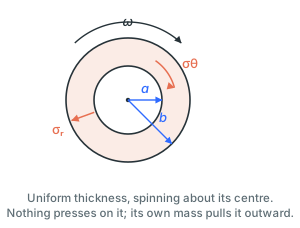
Enter units, rotational speed, outer diameter, internal diameter, density and poisson's ratio to work out the stress raised in a rotating disk by its own mass.
About Spinning Disk
Nothing is pushing on a spinning disk. The stress comes from its own mass: every part of it is trying to carry on in a straight line, and the material inboard has to hold it in. That pull is worst at the internal surface, where the least material is doing the most holding.
Cutting a hole in the middle roughly doubles the peak stress, however small the hole. A solid disk carries its highest stress at the dead centre; put a hole there and what remains at its edge takes twice the load. Additional Information compares the two.
Switching the unit system here converts the numbers, since ρω²r² carries dimensions and the arithmetic genuinely changes. Rev/min means the same thing either way, so only the diameters and the density move.
Uniform thickness, free at both faces, thin enough to treat as plane stress, and elastic throughout — once any of it yields the stress redistributes and these numbers no longer hold. Blades, a shrunk-on rim, a keyway or a press fit all change it, and none of that is here. Nor is any allowance for temperature, creep or the margin a real rotor is designed to.